Skip to product information
1 of 1

ACR GlobalFix V5 AIS EPIRB Cat I with hydrostatic release housing

ACR GlobalFix V5 AIS EPIRB Cat I with hydrostatic release housing

SKU:2851.62

Regular price €1.301,96 EUR
Regular price Sale price €1.301,96 EUR
Sale Sold out
Taxes included. Shipping calculated at checkout.
✅ Fast delivery
✅ Authorized dealer and marine specialist
✅ 2 year manufacturer warranty
✅ Not sure what fits? Contact us for advice
5.0 on Google (5 reviews)
Quantity

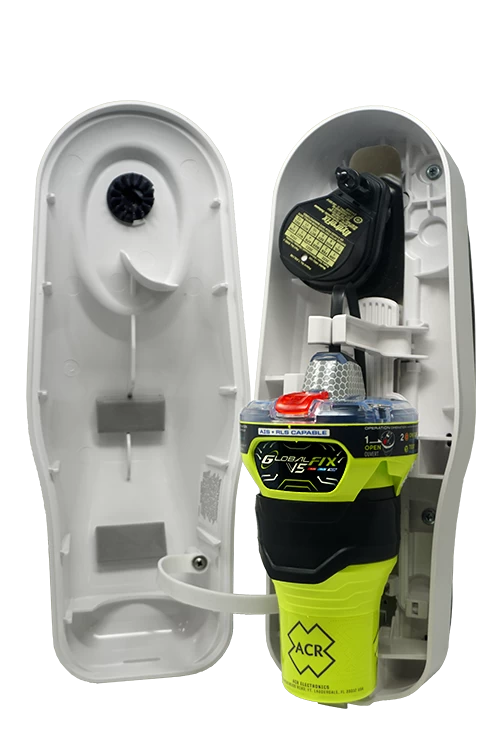
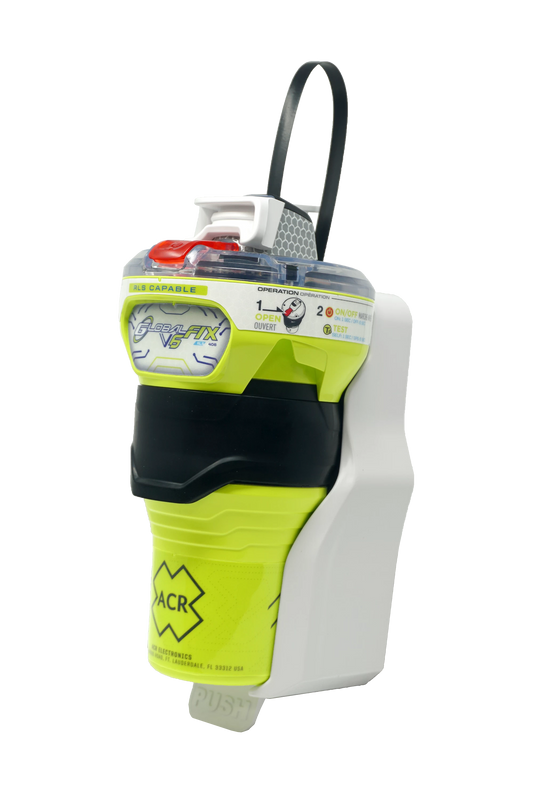
The ACR GlobalFix V5 Cat I is an AIS EPIRB emergency beacon in a hydrostatic enclosure. It releases automatically upon sinking and alerts satellites and nearby vessels simultaneously. Features Return Link Service and NFC.

AIS emergency beacon that releases itself if your vessel sinks
The ACR GlobalFix V5 in the Cat I configuration is housed in a hydrostatic enclosure and releases automatically at a depth of 1.5 to 4 meters. The beacon floats to the surface, gets wet, and begins transmitting without any further action required.

Once active, two things happen simultaneously. A digital mayday is sent on 406 MHz to the Cospas-Sarsat satellite network, and an AIS safety message is broadcast on VHF, which appears on the screen of every vessel with AIS in the vicinity. Return Link Service confirms that your call has been received via a blue flashing light.

Why choose the GlobalFix V5 AIS EPIRB Cat I?

  • Releases automatically: hydrostatic release at a depth of 1.5 to 4 meters
  • AIS alert to nearby vessels: vessels with AIS will immediately see you as a target on their screen
  • 406 MHz to Cospas-Sarsat: global alerting of official rescue services
  • Return Link Service: blue flashing light confirms that your emergency message has been received
  • White and infrared strobe light: visible in the dark and via night vision equipment
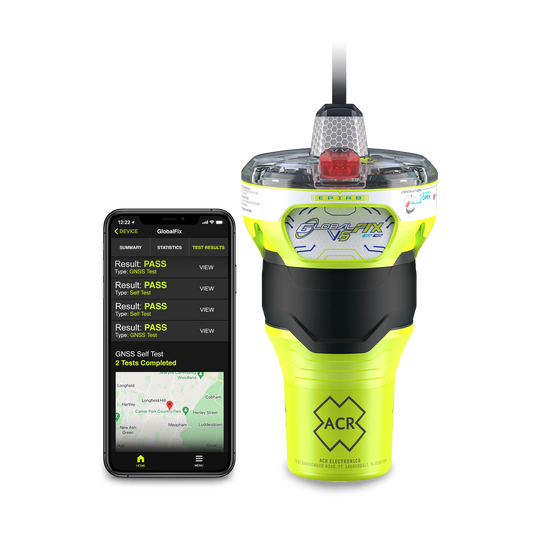
  • NFC and free ACR app: check the beacon with your phone

Who is this product made for?

This configuration is the most complete choice for vessels sailing offshore, for vessels that must comply with GMDSS requirements, and for owners who do not want to leave anything to chance. This applies to commercial shipping and fishing, but just as much to a motor yacht or sailboat making long crossings. The beacon is suitable for everything up to and including cargo ships and tugboats. When mounting, keep an obstacle-free area.

What does it offer you?

  • Works even if you can no longer do anything: in the event of rapid sinking, the beacon releases automatically
  • Two routes to help at once: satellite and AIS work in parallel
  • Potentially picked up much faster: vessels within VHF range can react immediately
  • Ten years without worries: the battery lasts for ten years
  • Broadly approved: Cospas-Sarsat, FCC, MED, MER, and Canada ISED
Technical specifications
Product type EPIRB, emergency beacon for on board
Model number RLB-44
Article number 2851.62
Transmit power 406.031 MHz 12 W and 121.5 MHz 50 mW plus or minus 3 dB
AIS Yes, AIS safety message for local alerting
Return Link Service Yes, confirmation directly on the beacon
NFC and mobile app Yes, read out with the free ACR app
Strobe White light and infrared
Dimensions (antenna raised) 470 x 109 x 111 mm
Weight (beacon only) 810 g
Battery Lithium Li/FeS2
Battery replacement After 10 years or after activation
GNSS receiver 72 channels, GPS, Galileo and Glonass
Activation Outside the bracket and wet, or manually in or out of the bracket
Waterproof 10 meters for 5 minutes
Floating Yes
Operating life At least 48 hours at -20 degrees Celsius
Temperature range Storage -30 to +70 degrees, use -20 to +55 degrees
Mounting Cat I, hydrostatic enclosure with automatic release
Warranty 5 years
Brand ACR
Additional features
Automatic release Hydrostatic release between 1.5 and 4 meters depth
AIS alerting Safety message with MMSI identification to ships with AIS within VHF range
Return Link Service Confirmation via Galileo, visible as a blue flashing light
Included Mounting hardware 9657, Cat I enclosure 2832 and HydroFix HRU 9490.1
HRU maintenance The HydroFix release has its own replacement interval; note the installation date
Approvals Cospas-Sarsat, FCC, MED, MER and Canada ISED
Frequently asked questions

What exactly is an EPIRB?

An EPIRB is an emergency beacon mounted on board a vessel. Once you activate it, it transmits a digital emergency signal on 406 MHz to the global Cospas-Sarsat satellite system, containing your position and your vessel's identification. Rescue services immediately know who you are and where you are.

Do I need to register my beacon?

Yes, that is mandatory. In the Netherlands, you register an EPIRB with the Rijksinspectie Digitale Infrastructuur (RDI). You will then receive an MMSI number that must be programmed into the beacon, which your supplier can do for you. A minimum of a Marcom-B certificate is required to operate an EPIRB.

What is the difference between Cat I and Cat II?

The difference lies in how the beacon is released from the bracket. A Cat I beacon is in a hydrostatic enclosure and releases automatically if the ship sinks, at a depth between 1.5 and 4 meters. A Cat II beacon is manually removed from the bracket by you. Both types can also be activated manually.

How long does the beacon continue to transmit?

The beacon continues to transmit for at least 48 hours at -20 degrees Celsius. This is the international requirement for EPIRBs.

How do I know if my beacon is still working properly?

Perform a self-test monthly. If the test is successful, the beacon is working. With this model, you can also read the test results with the free ACR app by holding your phone against the beacon.

What does AIS add to a standard EPIRB?

A standard EPIRB alerts official rescue services via satellite. An AIS EPIRB does that too, but additionally broadcasts a local signal that every ship and aircraft with AIS in the area sees immediately. They can then offer assistance right away, potentially even before the rescue service arrives.

Downloads and official information
View full details