
Collection: Actisense

Actisense • NMEA
Actisense for NMEA connectivity
Actisense gateways, buffers, multiplexers, interfaces and cables for NMEA 0183 and NMEA 2000 networks
Actisense is the specialist in NMEA connectivity. Their hardware makes NMEA 0183 and NMEA 2000 networks reliable, silent and interference-free, so that instruments, chartplotters, sensors and PCs communicate effortlessly with each other.
Whether you're doing a refit or setting up a completely new onboard network, Actisense provides the links that make the difference: gateways, buffers, multiplexers, interfaces and cables. Smart filtering and galvanic isolation protect your network and prevent data loss and noise.
Choose your series below and filter directly to the correct range for your installation.
-
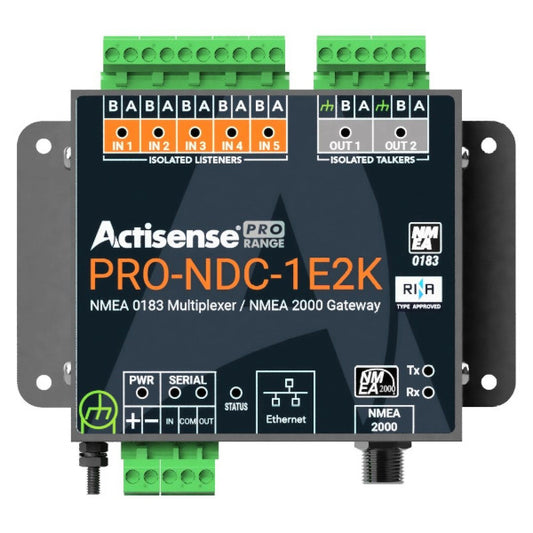
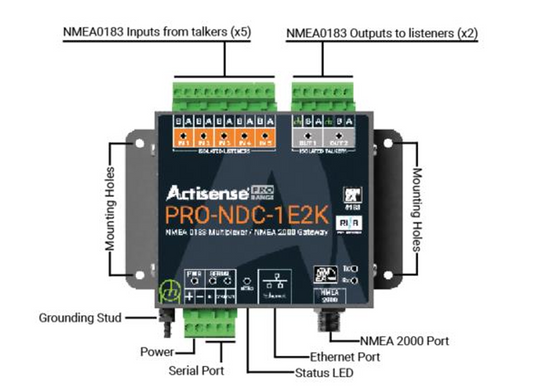
Actisense PRO-NDC-1E2K multiplexer with NMEA 2000 and Ethernet
Regular price €584,63 EURRegular price€695,99 EURSale price €584,63 EURSale -
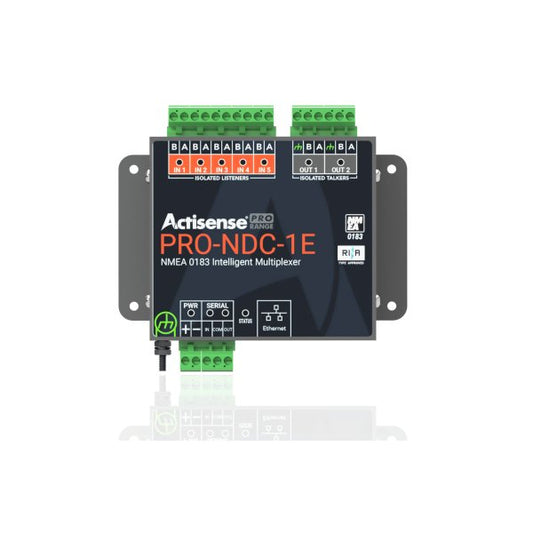
Actisense PRO-NDC-1E NMEA 0183 multiplexer with ethernet
Regular price €487,43 EURRegular price€580,27 EURSale price €487,43 EURSale -
Actisense W2K-1 NMEA 2000 Wi-Fi gateway (succeeded by the W2K-2)
Regular price €250,17 EURRegular price€297,82 EURSale price €250,17 EURSale -
Actisense WGX-1-ISO Wi-Fi gateway for NMEA 0183 and NMEA 2000
Regular price €331,57 EURRegular price€394,73 EURSale price €331,57 EURSale -
Actisense NGX-1-ISO NMEA 0183 to NMEA 2000 gateway
Regular price €237,47 EURRegular price€282,70 EURSale price €237,47 EURSale -
Actisense EMU-1-BAS engine data to NMEA 2000
Regular price €564,00 EURRegular price€671,43 EURSale price €564,00 EURSale -
Actisense NGX-1-USB NMEA 2000 to PC gateway
Regular price €253,67 EURRegular price€301,99 EURSale price €253,67 EURSale -
Actisense A2K-TDC-5M NMEA 2000 cable, 5 meters
Regular price €53,52 EURRegular price€63,72 EURSale price €53,52 EURSale -
Actisense A2K-TDC-6M NMEA 2000 cable, 6 meters
Regular price €56,65 EURRegular price€67,44 EURSale price €56,65 EURSale -
Actisense A2K-TDC-8M NMEA 2000 cable, 8 meters
Regular price €71,35 EURRegular price€84,94 EURSale price €71,35 EURSale -
Actisense A2K-TDC-10M NMEA 2000 cable, 10 meters
Regular price €76,73 EURRegular price€91,35 EURSale price €76,73 EURSale -
Actisense A2K-KIT-2a NMEA 2000 starter kit with 6-meter cable
Regular price €188,92 EURRegular price€224,91 EURSale price €188,92 EURSale -
Actisense A2K-KIT-1a NMEA 2000 starter kit with 2-meter cable
Regular price €178,89 EURRegular price€212,96 EURSale price €178,89 EURSale -
Actisense A2K-SBN-2 complete NMEA 2000 network for 8 devices
Regular price €132,06 EURRegular price€157,22 EURSale price €132,06 EURSale -
Actisense A2K-SBN-1 complete NMEA 2000 network for 4 devices
Regular price €108,77 EURRegular price€129,49 EURSale price €108,77 EURSale -
Actisense A2K-SCREWCAP-10-F female protective caps, 10 pieces
Regular price €9,78 EURRegular price€11,64 EURSale price €9,78 EURSale


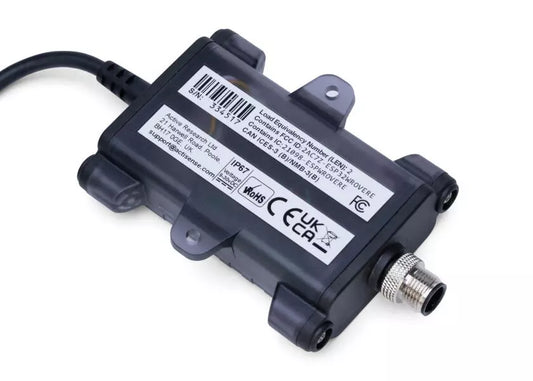

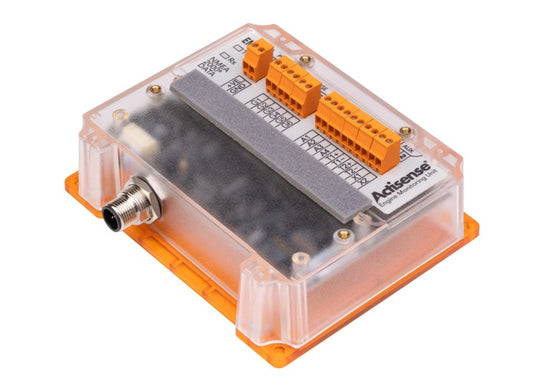

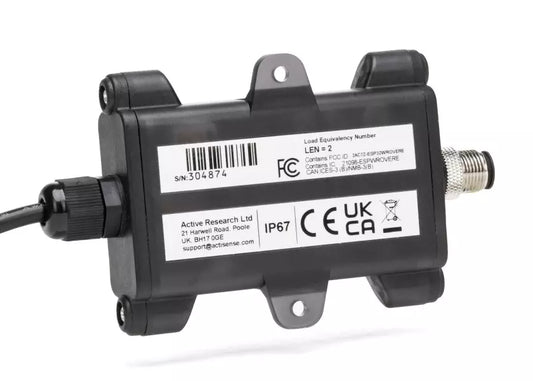


Actisense: making equipment talk to each other
Actisense does not make chartplotters or sensors. It makes the parts in between — the gateways, multiplexers and network components that get one piece of equipment to talk to another, including kit that is twenty years apart in age. That is usually why people end up here: something on board needs to reach something else. Pick the job below.
Gateways — which one do you need?
This is the question Actisense is best known for. The NGX-1 is the current generation and replaces both older models: you configure it either as an NMEA 0183 to NMEA 2000 converter, or as a NMEA 2000 to PC interface — one job at a time. The older NGT-1 (to a PC) and NGW-1 (0183 to 2000) are still available, including a SeaTalkNG and an AIS variant. Want it wireless too, then look at the W2K-1 and the WGX-1.
View gateways and NMEA 2000NMEA 0183 — multiplexers and buffers
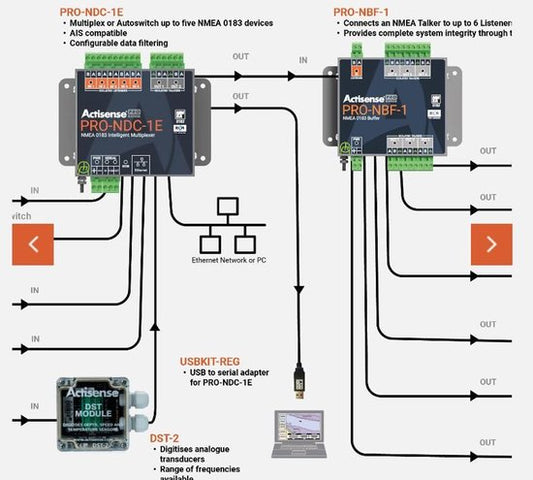
NMEA 0183 sends from one talker to a limited number of listeners, and that is where it runs out. A multiplexer merges several sources into one stream — AIS, depth and wind all into one plotter or laptop: the PRO-MUX-2, PRO-NDC-1E and PRO-NDC-1E2K. A buffer splits one output over several listeners without the signal collapsing: the PRO-BUF-2 and PRO-NBF-1. If a second device works when you unplug the first, you need a buffer.
View NMEA 0183Building an NMEA 2000 network
Starting from scratch is easiest with a kit: the A2K-KIT and A2K-SBN sets hold a backbone, terminators, power cable and tees in one box. The QNB-1 Quick Network Block is worth knowing about — instead of a chain of separate tees it gives you one block with several ports, which keeps a crowded installation tidy and cuts the number of connections that can corrode. Separate tees, 4-way connectors and terminators in every gender are all here too.
View NMEA 2000EMU-1 — engine data from analogue gauges
Most boats with an older engine have perfectly good analogue gauges and no way to get those readings onto a modern screen. The Engine Monitoring Unit reads the existing senders — revs, temperature, oil pressure, fuel — and puts them on the NMEA 2000 network. That means engine data on your plotter without replacing the engine instrumentation, which is the cheaper half of the job by some distance.
View NMEA 2000Ready-made networks, and the terminator trap
If you are starting a network from nothing, the A2K-SBN-1 and A2K-SBN-2 save you a box of loose parts: four or eight tees with the terminators already built in, and three metres of power cable. Read the limit before you buy — four and eight devices respectively, and Actisense states they cannot be extended. Want room to grow, then take a starter kit (A2K-KIT-1a, 2a or 4a) and build a proper backbone. One warning that costs people a second order: a network needs two terminators, and the two open ends of a run of tees are one male and one female. So you need an A2K-TER-M and an A2K-TER-F, not two of the same. The A2K-TER-U sidesteps that and shows you the network voltage with an LED.
View NMEA 2000Cables, connectors and mounting
Drop cables from 0.25 to 10 metres, and 100-metre bulk cable on a reel for a full refit. The field-fit connectors are the ones to remember: you pull the bare cable through a tight bulkhead pass-through first and fit the plug afterwards, so the hole only has to be as big as the cable. There are straight and right-angled versions in both genders, plus screw caps for unused ports and DIN-rail kits for a tidy electronics panel.
View cables and network partsWhich gateway for which job, and the network rules that decide whether it works — open for the comparison
The gateway comparison
| Model | What it connects | Choose it when |
|---|---|---|
| NGX-1 | NMEA 0183 ↔ NMEA 2000, or NMEA 2000 ↔ PC | You are buying new. It does either job, configured at setup — but one at a time, not both at once |
| NGT-1 | NMEA 2000 ↔ PC | You are extending an existing setup that already uses one, or you want software and diagnostics on a laptop |
| NGW-1 | NMEA 0183 ↔ NMEA 2000 | Straight conversion only. There are dedicated SeaTalkNG and AIS variants |
| W2K-1 | NMEA 2000 → WiFi | You want your boat data on a phone or tablet. Hangs on a single drop cable |
| WGX-1 | NMEA 0183 ↔ NMEA 2000, NMEA 2000 ↔ PC, and wireless | You want all of it from one box, at the same time |
The ISO and USB in the model names are the connection type, not a feature level: ISO is the isolated version for a permanent installation, USB the one that plugs into a computer. Not sure which fits your boat? Send us the type numbers of what you want to connect on both sides — that is the only way to be certain before you order.
The network rules that decide whether it works
Most "faulty sensor" calls are not a faulty sensor. An NMEA 2000 network is one continuous backbone with exactly two terminators, one at each end, and a single power feed roughly in the middle. Each drop cable stays under 6 metres and all drops together under 78. Go past that and the system works on a calm day and lets you down when it gets rough — which is exactly when you notice.
The fourth cause, after those three, is corrosion in a connector that sits somewhere damp. That is why the screw caps for unused ports are not an optional extra.
Old equipment on a new network
This is where Actisense earns its keep. An older wind instrument, a VHF with an NMEA 0183 output, an autopilot from two refits ago — with a gateway in between, most of it still has a place on a modern network. Whether it works depends on which sentences the old device actually sends and what your new display does with them, so send us the type numbers and we will check before you buy.


